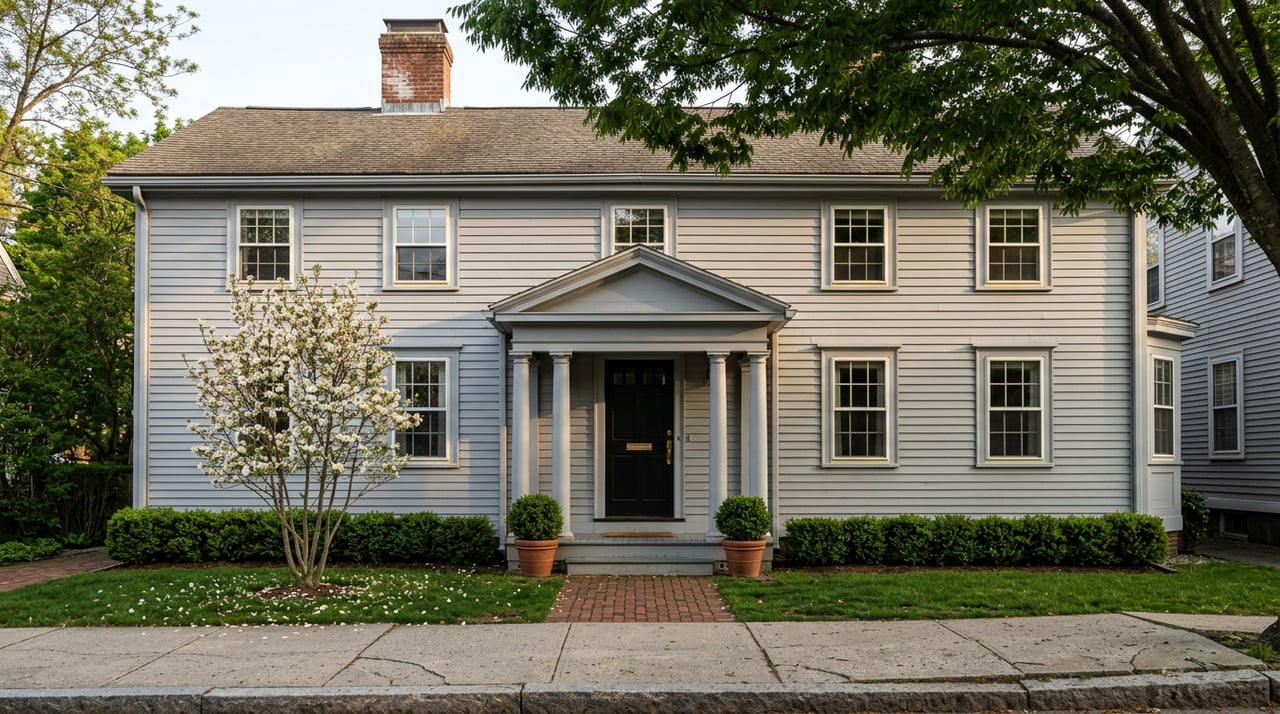
East Side Providence Market: Mount Hope's Price Shift
August 13, 2026
August 13, 2026
If you priced a house in Providence's Mount Hope neighborhood using last year's numbers, you'd walk into this summer's market expecting a bargain. You'd be wrong, and the reason why says more about how Providence's East Side actually works than any blended median ever could.
Search for Mount Hope's home values and you'll find a $496,000 median home price from July 2026 on one portal and a $659,900 median sale price from March 2026 on another, down 12 percent year over year according to that same source. Neither number matches what actually closed on Mount Hope's streets this summer. Five homes sold there between June 2 and June 18, 2026: 104 Woodbine Street for $875,000, 90 Pleasant Street for $895,000, 91 Evergreen Street for $850,000, 21 Mount Hope Avenue for $710,000, and 135 Cypress Street for $704,000. Every one of those closings landed between $704,000 and $895,000, a tight band that looks nothing like a $496,000 median.
That gap isn't a data error. It's the East Side telling you something about itself that the headline numbers can't.
The East Side of Providence posted a median sale price of $770,000 in March 2026, compared to $645,000 citywide, a premium of roughly 20 percent that has held steady for the past five years. That figure gets repeated constantly, and it's accurate as far as it goes. The problem is that it treats College Hill, Blackstone, Fox Point, Hope, Wayland, Oak Hill, and Mount Hope as one neighborhood with one price story. They're not.
Right now, current listing data puts the median asking price in College Hill at $1,097,500 and in Blackstone at $1,100,000. A few blocks away in Wayland, it's $649,900. In Oak Hill, it's $599,999. Fox Point sits at $769,900. Hope's actual median sale price, verified across recent transactions through May 2026, was $839,718, up 2.3 percent from the year before.
| East Side micro-neighborhood | Current price signal |
|---|---|
| College Hill | $1,097,500 (asking) |
| Blackstone | $1,100,000 (asking) |
| Hope | $839,718 (sold, May 2026, +2.3% YoY) |
| Fox Point | $769,900 (asking) |
| Wayland | $649,900 (asking) |
| Oak Hill | $599,999 (asking) |
That's a $500,000 spread inside a broker-defined district small enough to walk across in under an hour. A buyer comparing "East Side" listings against one blended median is comparing apples to a fruit basket.
Mount Hope has spent years marketed as the East Side's accessible entry point, the neighborhood where you could get the walkability and the architecture without College Hill's price tag. That framing made sense when the numbers backed it up.
They don't right now. The five June closings on Woodbine, Pleasant, Evergreen, Mount Hope Avenue, and Cypress Street sold within three weeks of each other, all landing between $704,000 and $895,000. That range overlaps directly with Hope's verified $839,718 median and sits well above the $649,900 and $599,999 asking prices two neighborhoods over in Wayland and Oak Hill.
If Mount Hope were still the bargain corner of the East Side, you'd expect its closings to trail those neighborhoods, not match or beat them.
The line that decides your price on the East Side isn't a street name. It's a zoning overlay most buyers never learn to look for until they're already under contract.
Here's the mechanism. College Hill's residential core sits inside a Local Historic District, first designated in 1960 and expanded in 1990 and again in 2021, when the Providence City Council added roughly 90 more properties to the overlay, bounded by Hope, Angell, Governor, and Young Orchard Streets, as the Providence Preservation Society reported. Any exterior change inside that district, from a new dormer to a rebuilt porch to new construction on a vacant lot, requires a Certificate of Appropriateness from the Providence Historic District Commission before a building permit can even be issued.
The 2021 expansion wasn't quiet. Brown University initially objected to including several of its own properties, and the fight over boundaries ran through multiple City Council meetings before a compromise passed, as the Brown Daily Herald reported at the time. That review layer protects the architecture that makes College Hill College Hill. It also means a buyer who wants to add a primary suite, expand a kitchen, or build an accessory unit there is signing up for a design review process on top of standard permitting, with no guaranteed timeline.
Mount Hope's housing stock is architecturally similar, with plenty of turn-of-the-century single and multi-families. Rhode Island's statewide accessory dwelling unit law took effect in 2024, requiring cities to allow ADUs by right on owner-occupied single-family lots, up to 1,000 square feet, without a public hearing or discretionary review, as PropertyZoned's Providence page explains. That law applies across Providence. But in College Hill's historic overlay, the ADU itself may be allowed by right under state law while its exterior still needs a Certificate of Appropriateness.
The pricing strength inside the historic core isn't going anywhere either. A Spanish Revival home at 612 Elmgrove Ave, on Providence's East Side, sold for $3.23 million, which Providence Business News reported in June 2026 as the second-highest residential sale in the city so far that year. The four-bedroom home, built in 1930 and renovated by Providence-based Hill & Harbor, sits on grounds centered around what the listing firm described as the city's oldest oak tree. Compare that to a mixed-use property at 756-758 Hope St. in the Hope Village commercial corridor, which sold for $1.83 million this summer, five residential apartments alongside longtime neighborhood retail.
Both are East Side sales. Neither tells you what the other neighborhood is doing.
Is Mount Hope still the East Side's most affordable neighborhood? Not based on what actually closed this summer. Its June 2026 sales clustered between $704,000 and $895,000, which overlaps with Hope's verified median and sits above Wayland and Oak Hill's current asking prices. The "affordable East Side" label needs an update.
How do I find out if a specific East Side address is inside a local historic district? The Providence Historic District Commission maintains maps of all nine locally designated districts, including College Hill, Broadway, and Armory. Any exterior work inside those boundaries requires a Certificate of Appropriateness before a building permit is issued.
Does a historic district designation help or hurt resale value? Preservation advocates argue that locally designated districts appreciate faster and hold value better in downturns than comparable undesignated neighborhoods. That's a real consideration, but it comes with a trade-off in renovation flexibility and timeline that every buyer should weigh against their own plans for the property.
If you're trying to figure out which East Side pocket actually fits your budget and your renovation plans, that's exactly the kind of question worth working through before you write an offer, not after. James Hall works these streets block by block. Schedule a free consultation and get a read on the market that's specific to the address you're actually considering, not the neighborhood-wide average.
This article is general information, not legal, tax or financial advice. Consult a qualified professional about your situation.
Stay up to date on the latest real estate trends.

Get assistance in determining the current property value, crafting a competitive offer, writing and negotiating a contract, and much more. Contact me today.